Features
Everything below is part of one package. Nothing is bought separately and nothing is installed afterwards – the less used parts are simply switched on in the settings as extensions.
Writing
An editor that stays out of the way, and content types that a magazine really uses.
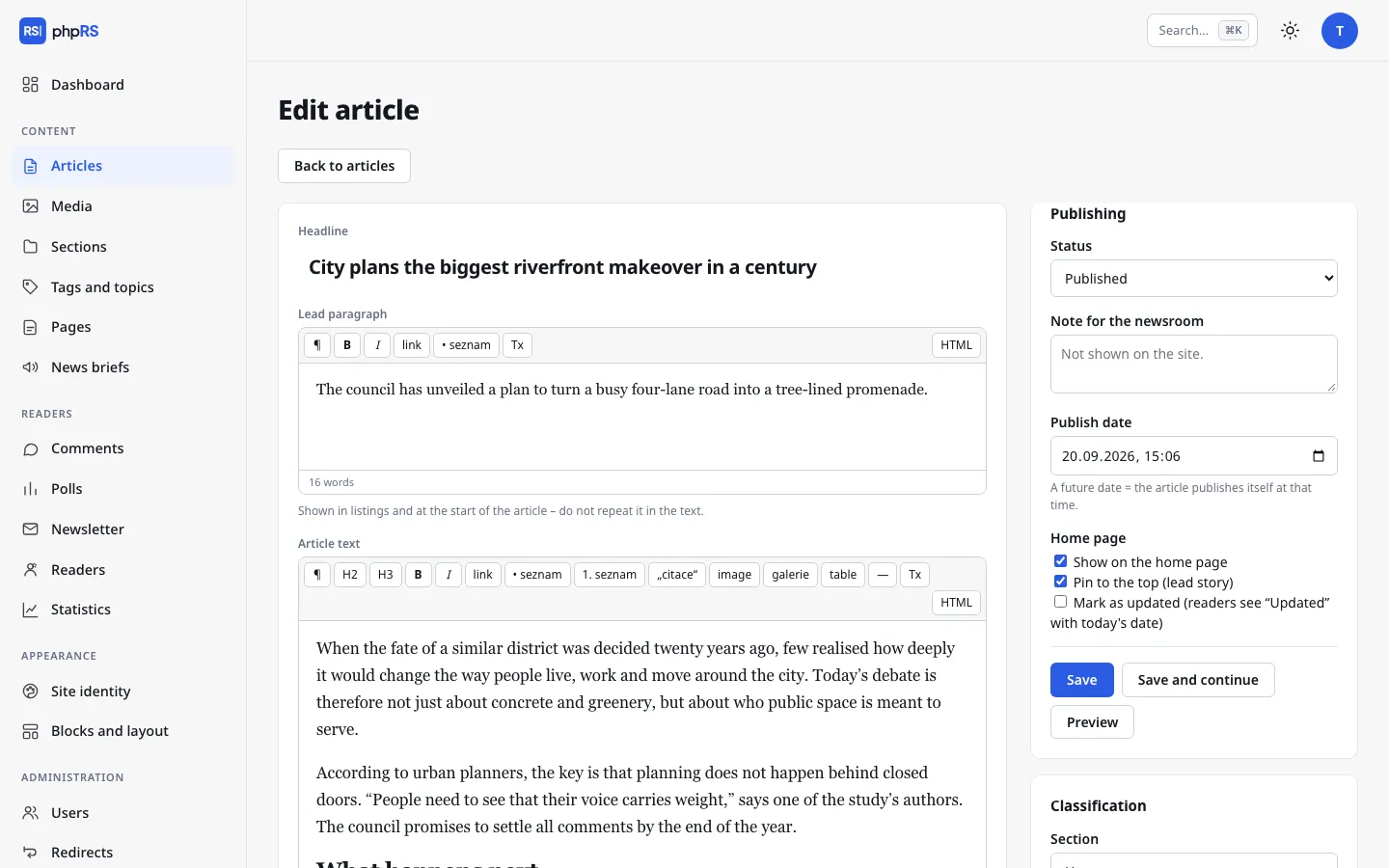
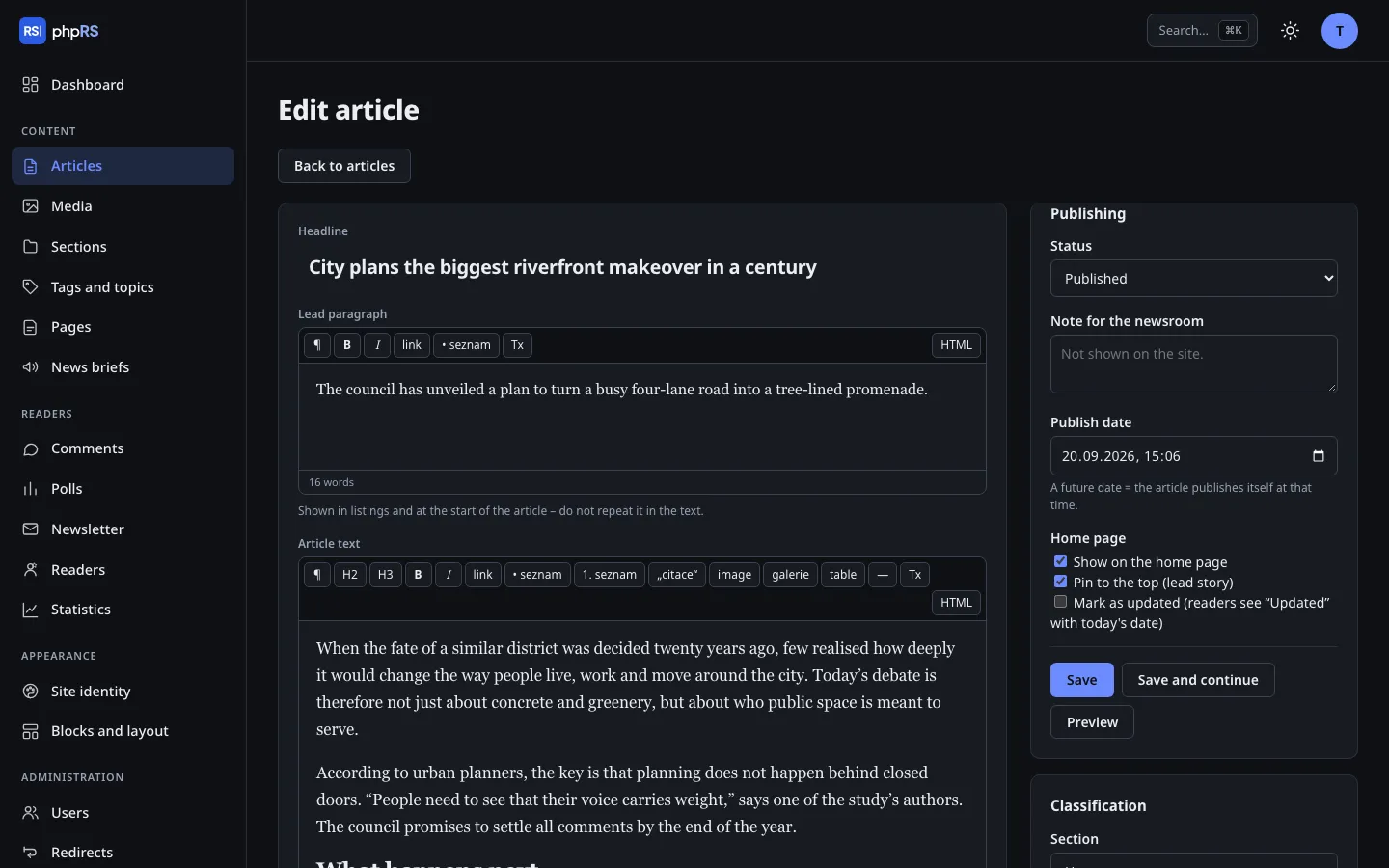
- WYSIWYG editor with no third-party libraries
- Headings, quotes, tables, photo galleries, attachments. Clean output, no clutter in the HTML.
- Video and social media posts from a plain URL
- You paste a link, the system does the rest. Third-party content loads for the reader only after a click.
- Revisions and version comparison
- Every save is a revision. You see the differences side by side and can restore any version.
- Drafts are saved continuously
- In the browser and on the server. A lock makes sure two people do not edit one article at the same time.
- Article templates and content types
- Long read, Photo story, Interview; live coverage, review with a rating, podcast.
- Scheduled publishing
- The article goes out at the set time – in the time zone of the site, not of the server.
Newsroom
From a single author to an editorial team with a proofreader and a front page editor.
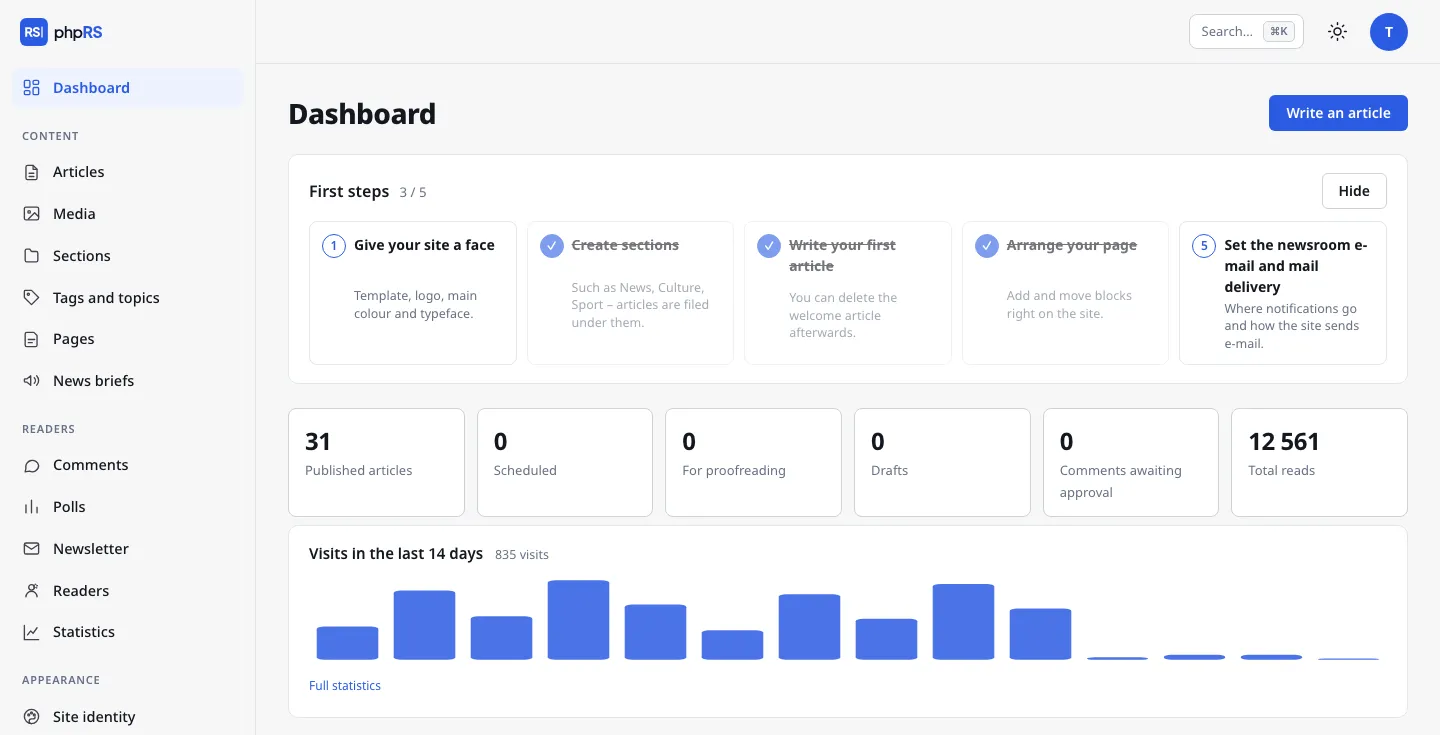
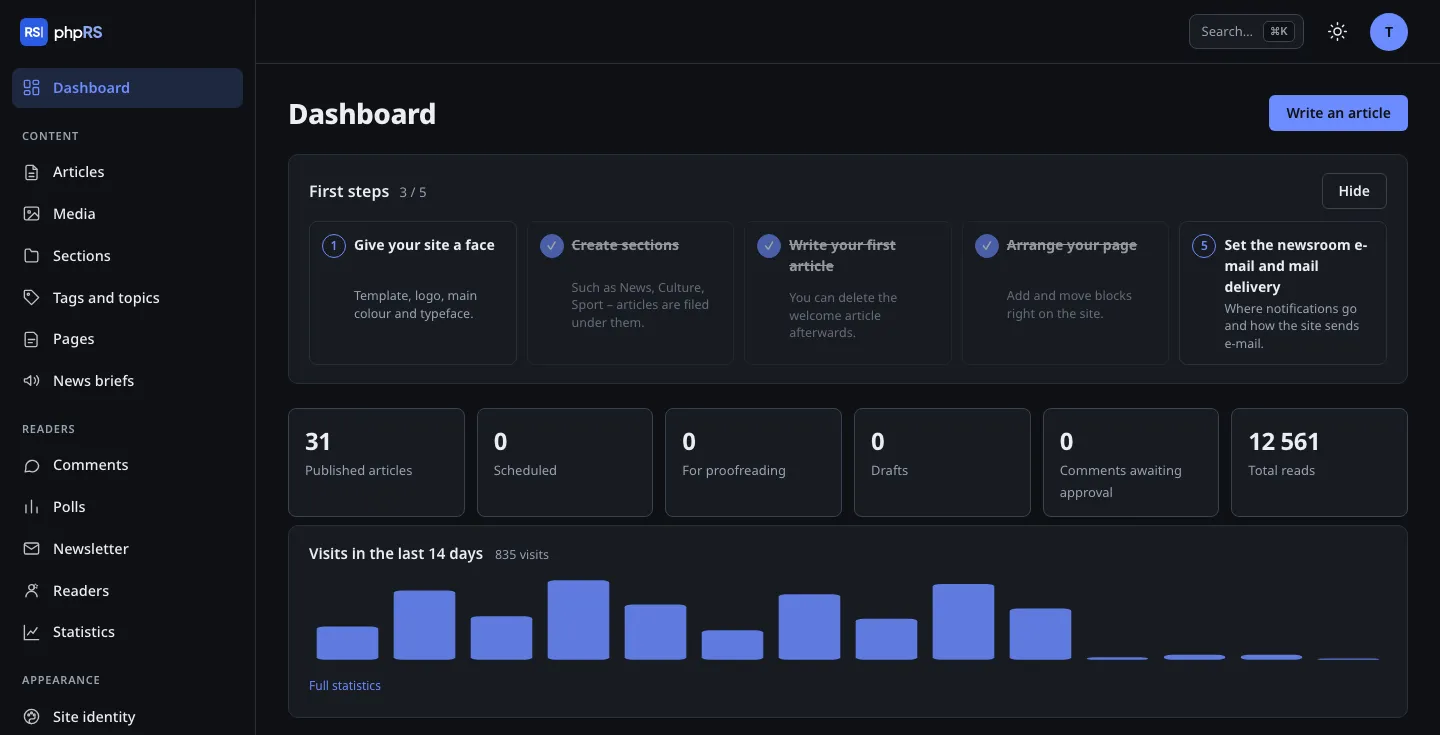
- Roles and permissions
- Author, editor, administrator. The right to publish is separate. Access can be limited to selected sections.
- Handover for proofreading
- Draft → for proofreading → approved → published. Handovers and returns are announced by e-mail.
- Editorial calendar and front page
- What goes out when and what is at the top of the site – in one place.
- Editing directly on the site
- You fix a typo on the page where you found it. This works for articles and pages.
- Command palette
- Ctrl/⌘+K: find an article, start a new one, jump to the settings. No clicking through menus.
- Bulk actions and audit log
- Move, publish or delete several articles at once. Important changes are logged.
Appearance
Three templates, a site identity and a layout that you put together directly on the page.
- Three built-in templates
- Classic Newspaper, Modern Magazine and Minimal.
- Site identity
- Logo, colour and fonts are set once and the templates take them over.
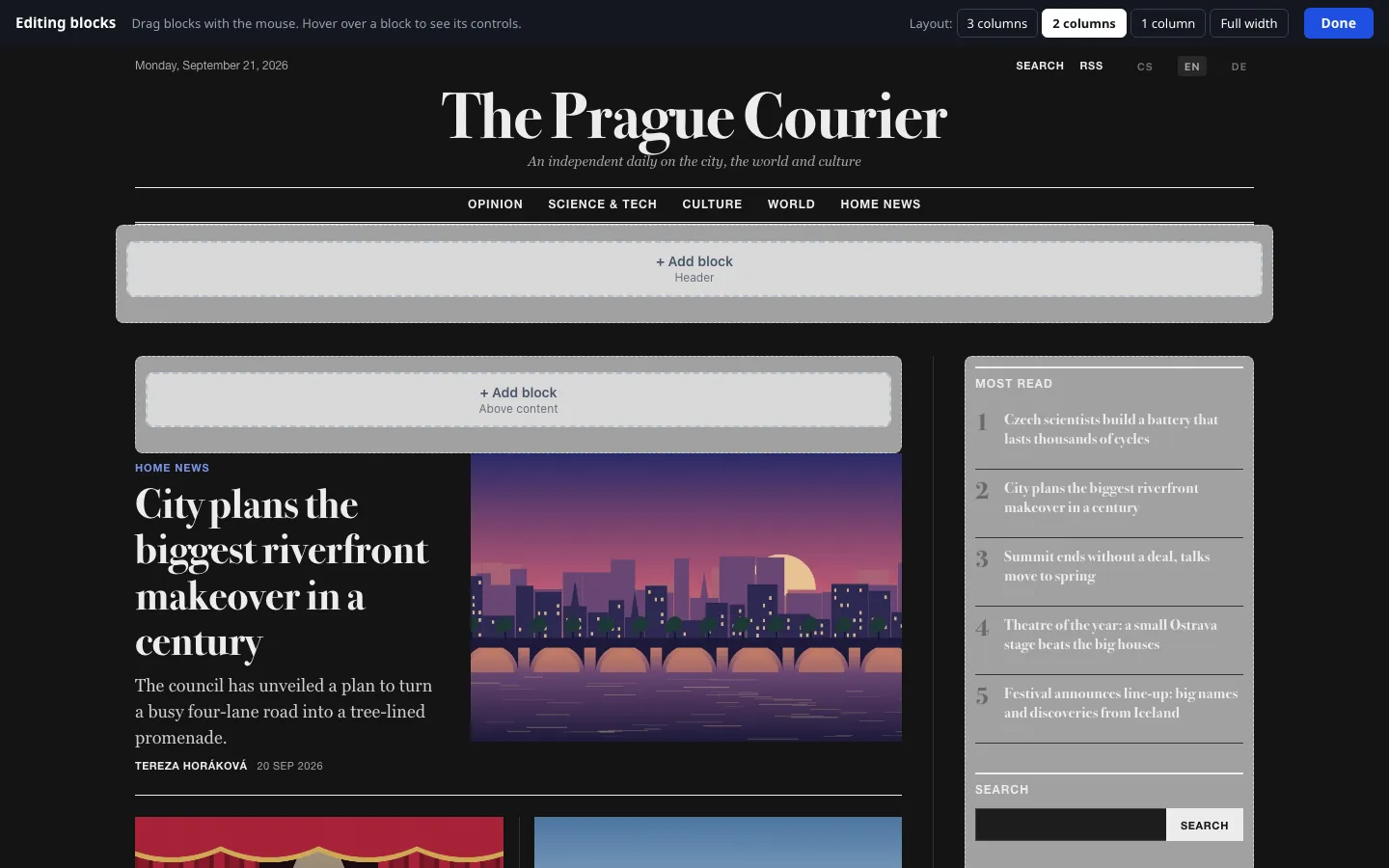
- Dark mode
- In all templates and in the administration. It follows the reader's system and can be switched.
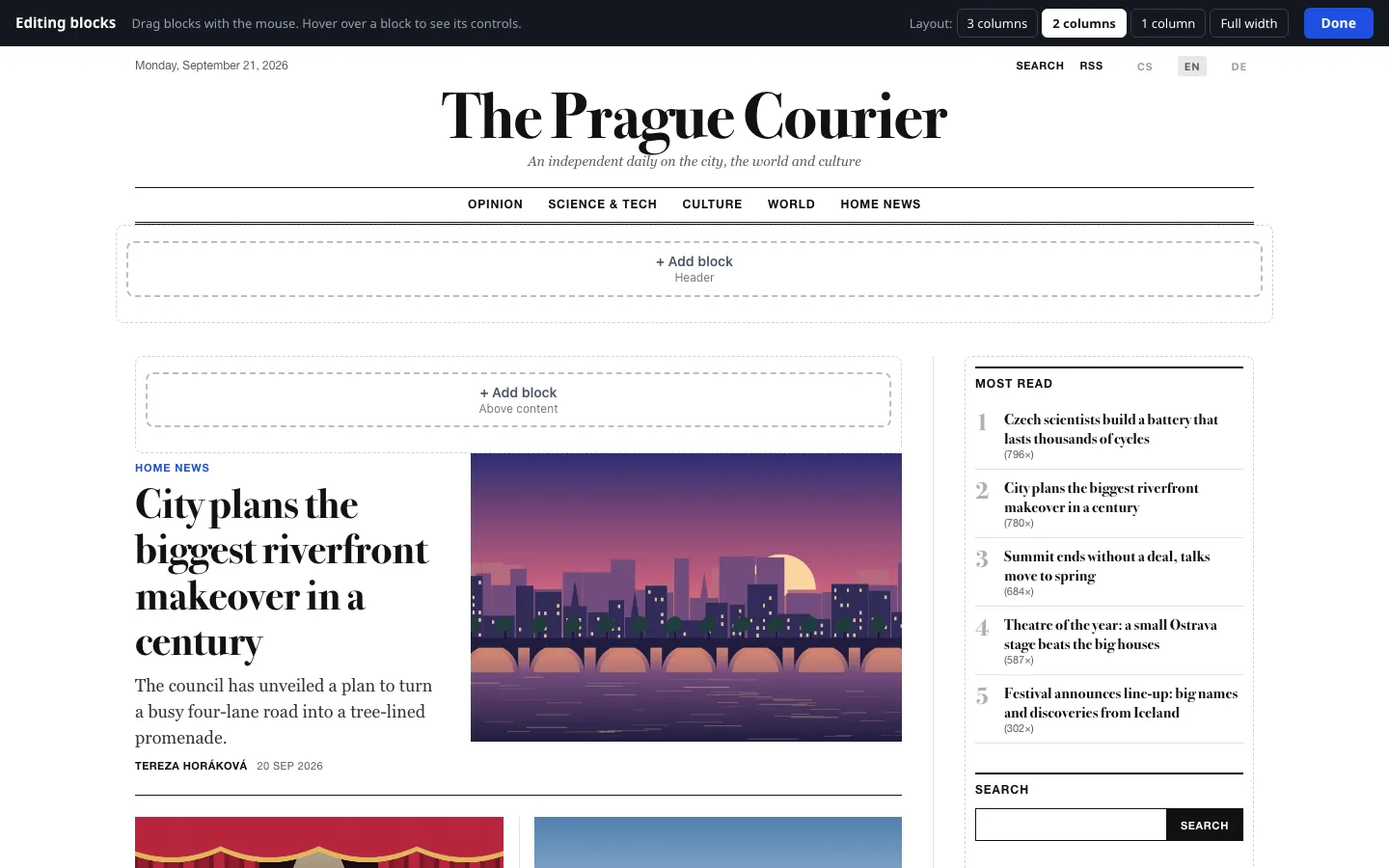
- Visual block editor
- You drag columns and blocks on the live page – you see the same thing as the reader.
- Custom template
- Plain PHP and CSS in one folder. The system checks the template before it is switched on.
- Images without layout shifts
- Dimensions, WebP variants and the placeholder colour are filled in automatically.
Readers and revenue
Tools a magazine uses to build its audience and pay for its operation.
- Comments with moderation
- Antispam without cookies and without third-party services.
- Registration without a password
- The reader logs in with a link from an e-mail. Saved articles, newsletter subscription, comments under their own account.
- Locked content and a soft paywall
- Part of the content only for logged-in readers or subscribers; a few locked articles per month can be free.
- Newsletter
- Manual and automatic selection of new articles, separately for each language of the site. A queue with retries.
- Web Push
- Browser notifications about new articles, with no third-party service.
- Advertising system
- Positions, targeting by section, timed campaigns and a report of impressions and clicks.
SEO and AI search
So that both people and machines find the article – and so that you control what machines are allowed to do.
- Structured data
- Schema.org for articles, reviews, podcasts, breadcrumbs and the author.
- Sitemap, RSS and JSON Feed
- Generated automatically, including language versions.
- IndexNow
- Search engines learn about a new article right away.
- llms.txt and Markdown versions of articles
- Clean text for language models, if you want that.
- AI crawler control
- You decide which bots you let in – in the settings, not by editing robots.txt by hand.
Languages
A multilingual site and a multilingual editorial team.
- Language versions of the site
- Czech, Slovak, English, German – with hreflang and linked translations.
- Administration in four languages
- Each user chooses their own. So does the installer.
- E-mails in the language of the recipient
- Newsletters and system messages.
- Site time zone
- Independent of the server settings.
AI – optional
Switched off until you enter your own key. Nothing is sent anywhere without your knowledge.
- Assistant in the editor
- Headlines, standfirst, summary, tags, proofreading, image descriptions, article translation. Through the Claude API.
- Connection to Claude (MCP)
- Claude manages content and writes custom templates. It cannot touch the system code, the users or the server.
Operation and security
Things you appreciate only when something goes wrong. Here they are ready in advance.
- Signed updates
- One button, an Ed25519 signature. Security releases install themselves.
- Backups, also off the server
- Weekly and before every update; a copy to FTP or S3. Restore from the administration.
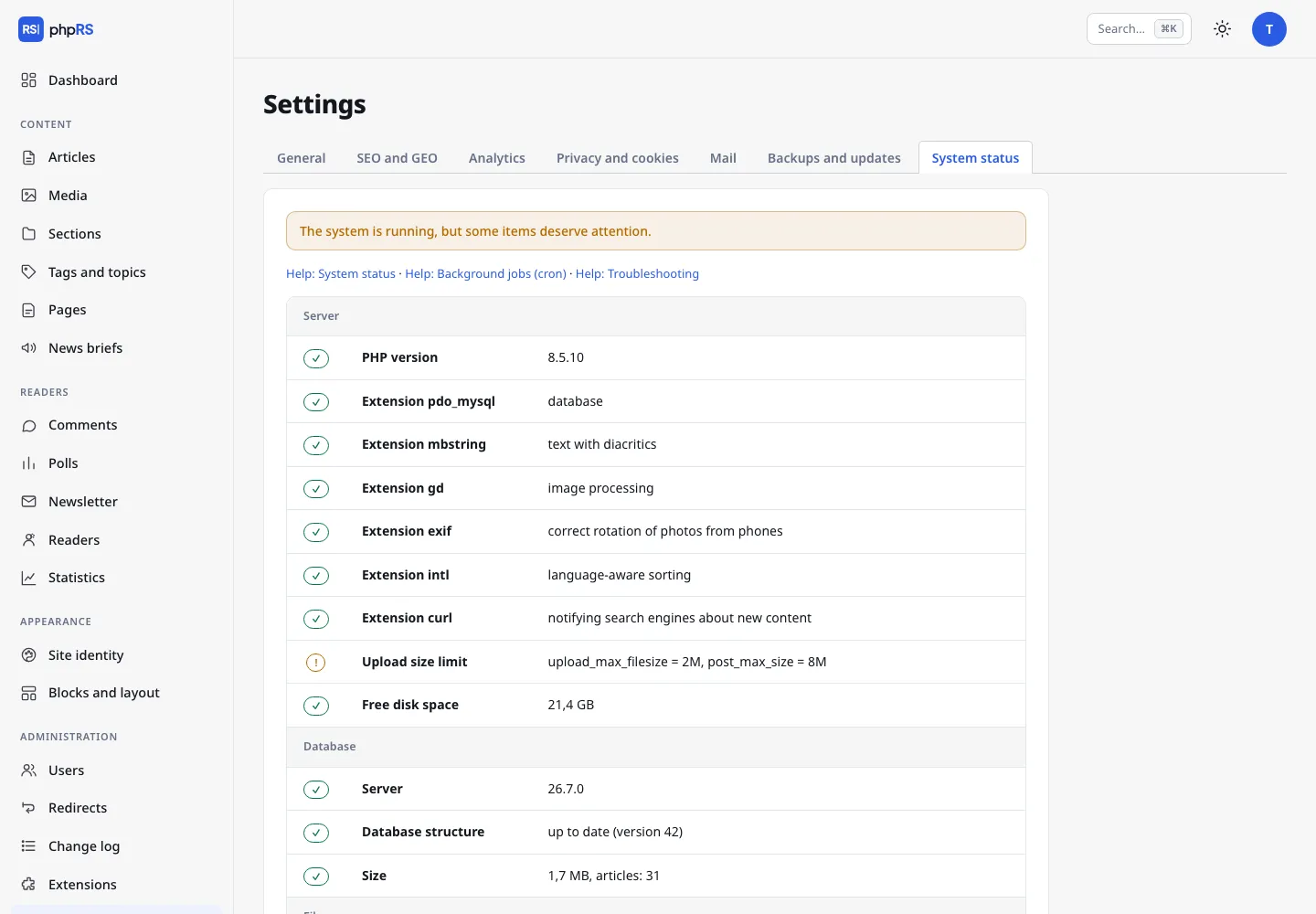
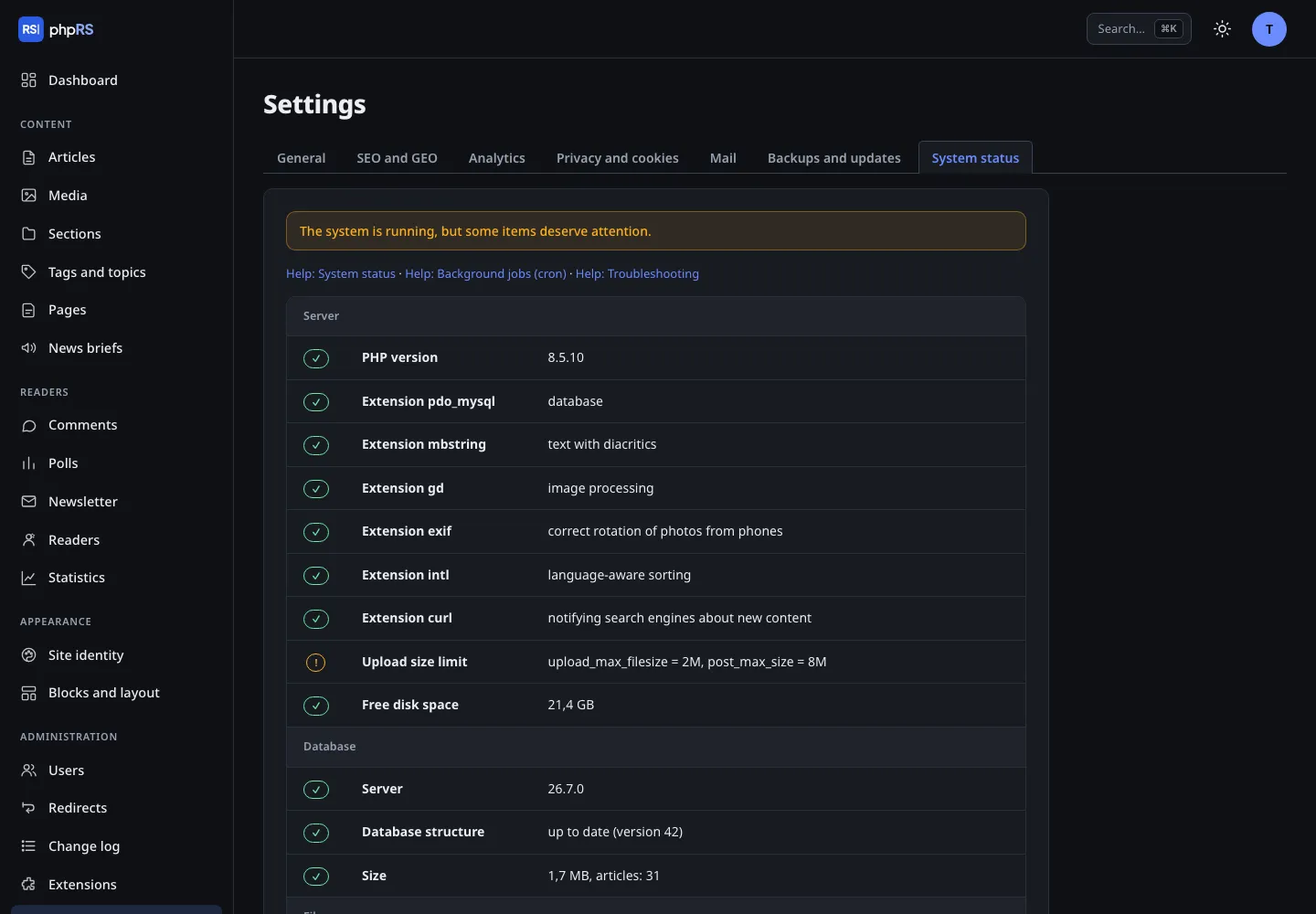
- System status
- Server, database, permissions, security, mail, cron – with advice on what to fix. Also as JSON for monitoring.
- Two-factor login
- TOTP with backup codes. The account is locked after repeated failures.
- Core integrity check
- Files are compared with the signed file list of the release.
- Mail over SMTP with a queue
- Undelivered messages are retried; an overview of recent messages.